

The National Association of Insurance and Financial Advisors (NAIFA) submitted formal comments to the Internal Revenue Service in response to Notice 2025-68 regarding the implementation of Section 530A Trump Accounts. Read NAIFA coverage in Investment News, 401kSpecialist and Advisor Magazine.
While NAIFA offered specific recommendations on investment flexibility and ERISA clarification, NAIFA made clear that the long-term success of Trump Accounts will ultimately depend on one critical factor: meaningful inclusion of financial advisors in the program’s implementation and ongoing administration.
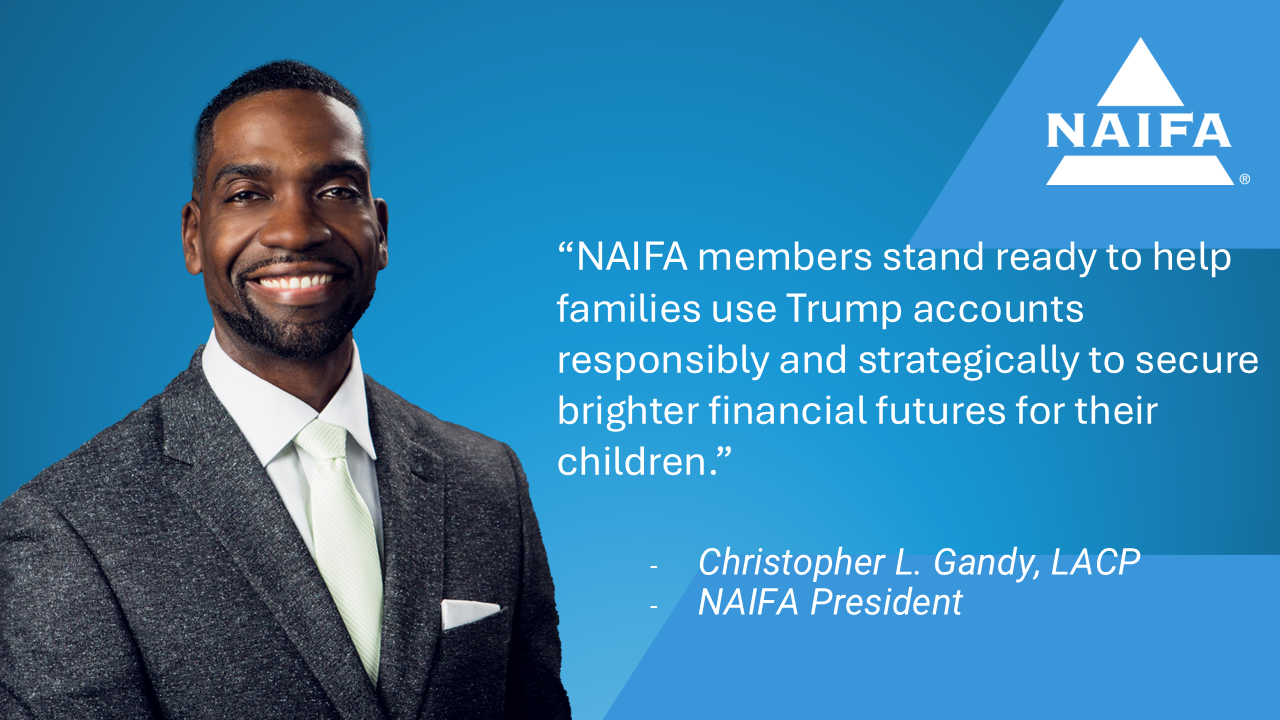
“Trump Accounts represent a meaningful opportunity to promote early savings and financial security from birth,” said NAIFA President Christopher L. Gandy, LACP. “But accounts alone do not build wealth; relationships, education, and disciplined guidance do. NAIFA members stand ready to help families use these accounts responsibly and strategically to secure brighter financial futures for their children.”
In its comments, NAIFA recommended that the Treasury Department work with Congress to amend current investment restrictions that limit Trump Accounts primarily to index funds and ETFs. While these investments can be appropriate in many circumstances, NAIFA cautioned that overly restrictive investment menus could limit customization and long-term performance.
“Restricting access to broader investment options limits customization and prevents advisors from tailoring strategies to the specific needs of the individual,” Gandy said. “Financial experts are positioned to responsibly advise their clients on the multitude of investment options available to them and then use that knowledge to maximum value and returns over time.”
NAIFA also called for clear confirmation that Trump Accounts themselves are not subject to ERISA jurisdiction. Because employers may contribute to these accounts but cannot establish or maintain them, NAIFA emphasized that the accounts should not be treated as employer-sponsored benefit plans. Subjecting the accounts to ERISA requirements could create administrative conflicts, litigation risk, and barriers that discourage employer participation, undermining the program’s effectiveness and limiting family access.
Beyond these technical recommendations, NAIFA emphasized that families, particularly lower- and middle-income households, will need trusted professionals to help them navigate complex rules and long-term planning decisions.
NAIFA members are uniquely positioned to:
- Simplify complex contribution and withdrawal rules for Main Street families
- Integrate Trump Accounts into broader financial strategies alongside 529 plans, insurance coverage, retirement savings, and emergency planning
- Encourage small, consistent contributions that harness the power of compound growth
- Open conversations with new parents, grandparents, employers offering family-focused benefits, community groups, churches, and schools
- Provide ethical, client-centered guidance under professional standards of conduct.
Without clear pathways for advisor participation, families may face unnecessary confusion, missed opportunities, or unintended tax consequences. By contrast, when financial professionals are included in the framework, Trump Accounts can serve as an entry point to broader financial security conversations that last a lifetime.
NAIFA commended the Treasury Department and IRS for seeking public input and reiterated its commitment to working collaboratively to ensure Trump Accounts achieve their intended purpose: expanding access to long-term savings and strengthening financial security for the next generation.